A temple chariot — ter in Tamil — is not a vehicle in the engineering sense of a chassis. It is a timber stack: a base frame, rising layers of diminishing superstructure, and a finial tier, all assembled from members that are pegged, wedged and tied rather than fixed. The whole thing is built to move twice: once through the streets, and once apart.
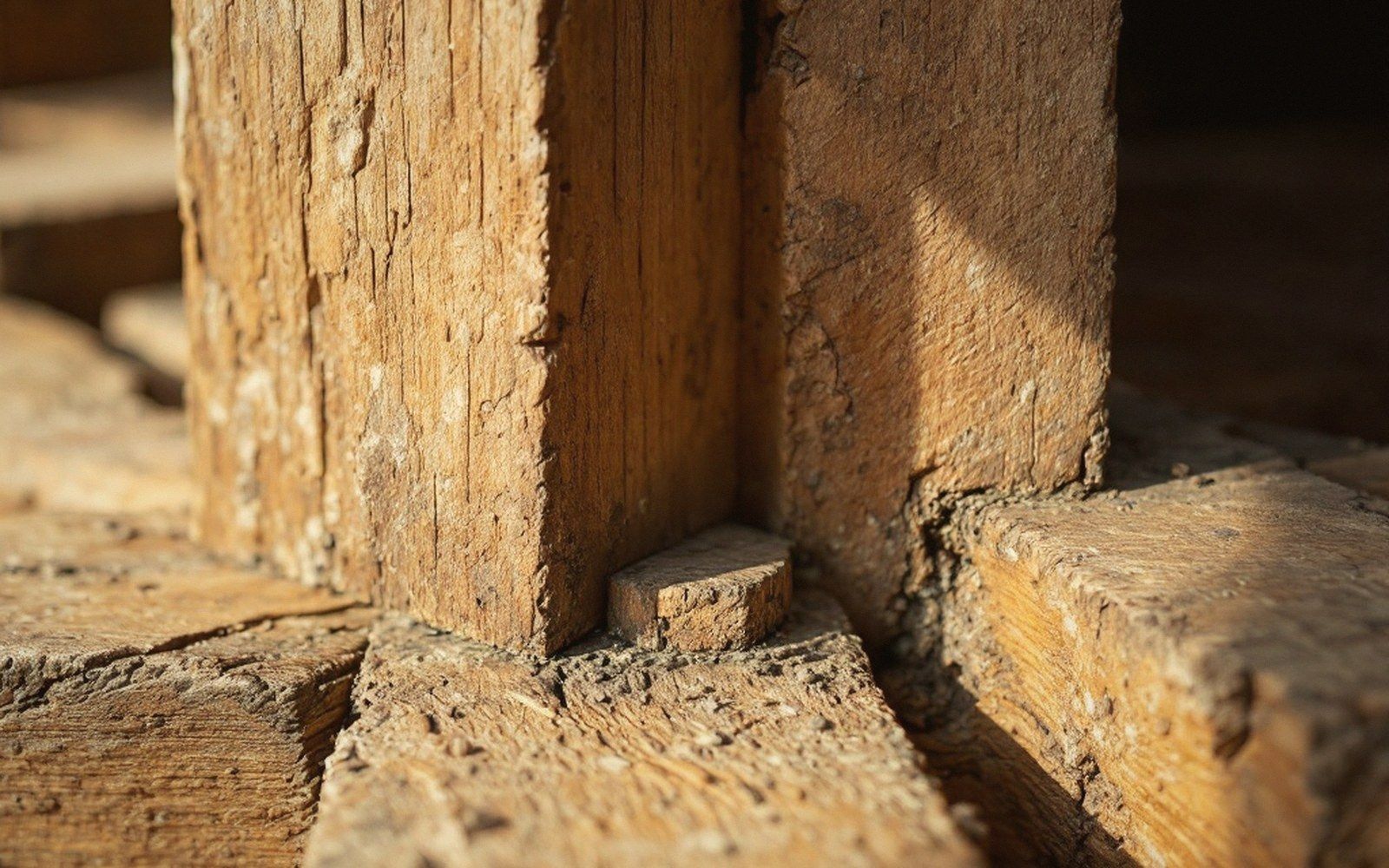
The base frame takes the full vertical load and the shock of starting and stopping. Hardwood beams — typically teak or a comparably dense timber — are laid in a rectangular grid and joined at the corners with mortice-and-tenon or half-lap joints, the intersections pegged with wooden pins driven into pre-bored holes. No metal fasteners and no adhesive. The pegs allow micro-rotation under load; the joint does not crack because it is not rigid. A bolted frame on the same scale would work until it didn't.

Peg joints — allow micro-rotation under shock loads; rigidity would cause splitting
Above the base, each storey of the superstructure is framed separately. Lighter members — often a secondary hardwood, sometimes a softer species where load is low — form the walls of each tier, their uprights tenoned into horizontal rails. The taper of the whole elevation is achieved not by shaping individual members but by stepping each tier's frame inward from the one below, so the plan shrinks storey by storey and the profile reads as a pyramid. The structural logic is the same as a gopuram's setback: less mass higher up, the centre of gravity kept low.
The connection between tiers is the critical joint. Vertical king-posts or tie-members pass through one tier into the next, held by wedges driven transversely through the post. Knock the wedge out, and the tier above lifts free. This is not a failure mode — it is the design. After the festival, the chariot is dismantled by tier, the members numbered or notched for sequence, stored under cover and reassembled the following year. A frame built with mortar or metal would be a ruin within two seasons; a pegged frame, maintained and re-wedged, runs for generations.
| No. | Item | What it is |
|---|---|---|
| 01 | Storey framing | each tier assembled independently, uprights tenoned into rails |
| 02 | Taper | achieved by stepping each tier's plan inward, not by shaping members |
| 03 | King-post connection | vertical posts pass through tiers, held by transverse wedges; knock the wedge, the tier lifts free |
| 04 | Dismantling | members numbered or notched in sequence; stored, reassembled annually |
The lateral loads from hauling — ropes attached to the axle frame, hundreds of people pulling — are handled by the deep section of the base beams and by the sheer mass of the loaded structure. The chariot does not brace against the pull; it is heavy enough that the base frame distributes it without racking.
Peg, wedge, sequence, repeat.