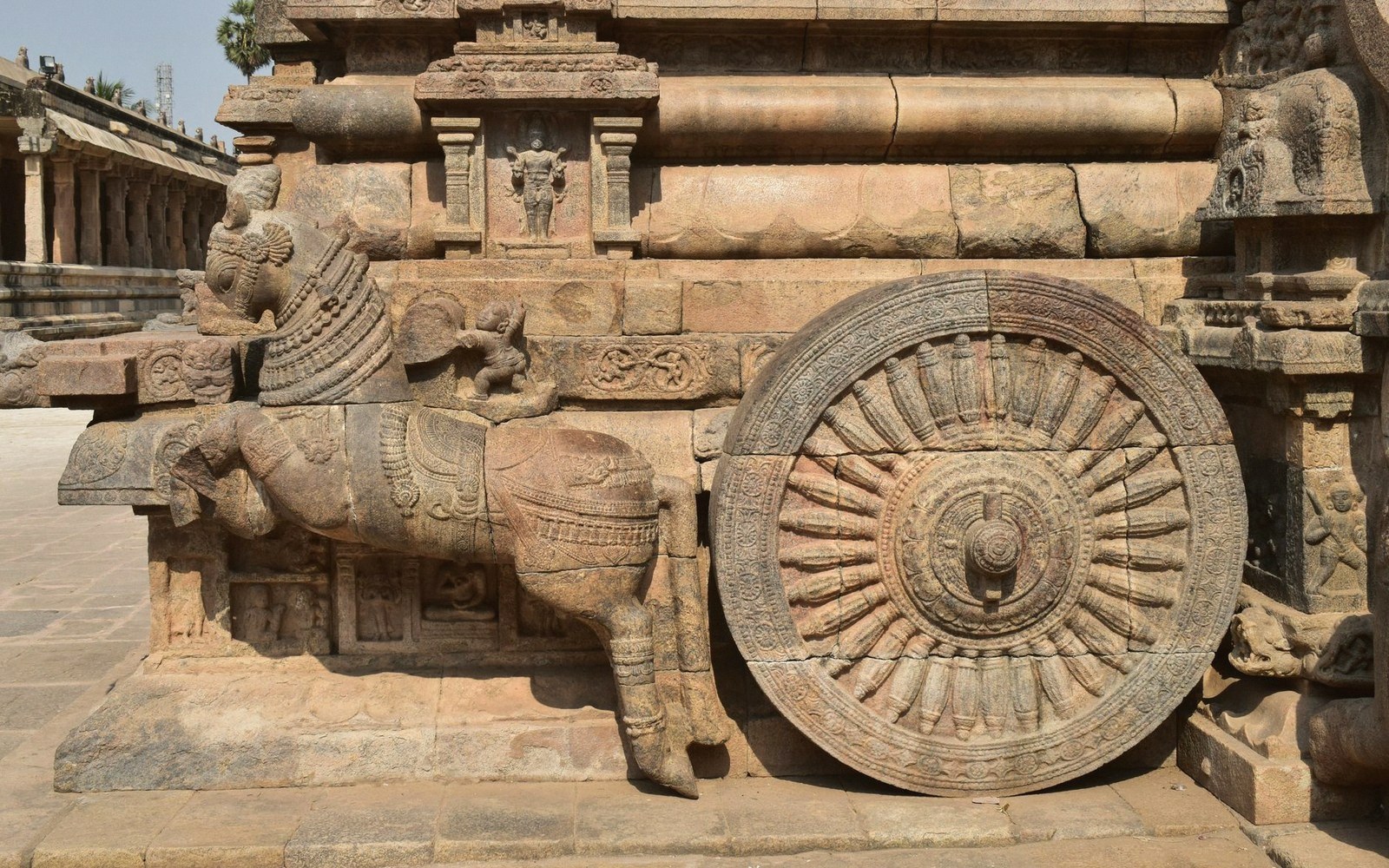
How the wheel holds together
The rim of a large chariot wheel is not a single piece of timber — no available plank is wide enough or long enough to serve. It is built from segments, each called a felloe, cut from dense hardwood and arranged end-to-end around the circumference. A wheel of typical size might use a dozen or more felloes, each sawn so that the grain runs roughly tangent to the rim rather than across it, which puts the working load along the fibre rather than against it. The joint between adjacent felloes carries shear; the joint at the spoke shoulder carries the radial load. Neither is left to fasteners alone.
Spokes are driven into a turned wooden hub at the centre and tenoned into the felloe ring at the outer end. The assembly at this stage is essentially a friction structure — tight fits, no mortar, no adhesive — and it would work loose the moment it dried out in summer if nothing bound it radially. That binding is the iron tyre.

Spoke — radial member, tenoned into hub at centre, into felloe at rim
The tyre is forged slightly shorter in circumference than the assembled wheel. It is heated until it expands enough to be knocked over the rim, then quenched with water. As it contracts, it pulls every felloe joint tight and locks every spoke shoulder against its seat. The compression it introduces is not incidental — it is the reason the wheel holds. Remove the tyre, and the rim would spread. The joint geometry does the geometry; the tyre does the clamping.
A chariot wheel large enough to give the vehicle its necessary ground clearance — and they are large, some running well over a metre in diameter — imposes substantial load through the axle. The hub must be long enough to distribute that bearing load without crushing the wood, and it is usually reinforced with iron ferrules pressed over each end. The axle itself, turned from hardwood or sheathed in iron at the bearing surface, rotates against the hub, which means the hub bore wears. On a chariot that is hauled out for a festival once a year, that rate of wear is slow; the wheel may last generations before the bore becomes sloppy enough to matter.
Tyre contraction is the structural mechanism, not a finish detail
Grain orientation in felloes determines where the timber is strong
Hub bore length governs how axle load spreads into the wood
Spoke count trades joint complexity against load per tenon
The spoke count matters too. More spokes mean more joints to manage but a hub under lighter individual load at each tenon. Fewer spokes simplify the assembly but concentrate stress. In practice the count is a compromise arrived at by the carpenter, not derived from calculation — but the principle is the same one a wheel-wright anywhere would recognise.
The chariot's turning circle set the width of the streets around the temple. The town plan is a vehicle constraint.