The radius comes first
A temple chariot — a ter in Tamil — is not steered the way a wheeled vehicle with a pivoting front axle is steered. It has no such axle. The wheels are fixed to the frame, and the whole structure is hauled by ropes attached to the front. To turn a corner, the hauling team on the rope and the pushing teams at the side work the vehicle around the bend by brute angular force, pivoting the rigid frame about a point somewhere near its centre. The swept area of that manoeuvre — the arc traced by the outermost corner of the frame as it negotiates a ninety-degree turn — is what sets the minimum usable width of the street.
The vehicles are large. A major temple chariot may stand twelve metres tall, with a platform base three to four metres wide and a comparable length. The base dimension is constrained by the column spacing of the temple gateway it must pass in front of, but once the dimensions of the frame are fixed, the geometry of the turn is inescapable: a rigid rectangular body pivoting through a right angle sweeps a predictable area, and the street must be wide enough to contain it. The outer corner of the frame, tracking through the turn, cuts the widest arc; behind it, the rear of the vehicle swings outward as the front comes around. Both movements must clear the walls and buildings that line the route.

Typical chariot height: up to approximately 12 m for major vehicles
The circumambulatory street
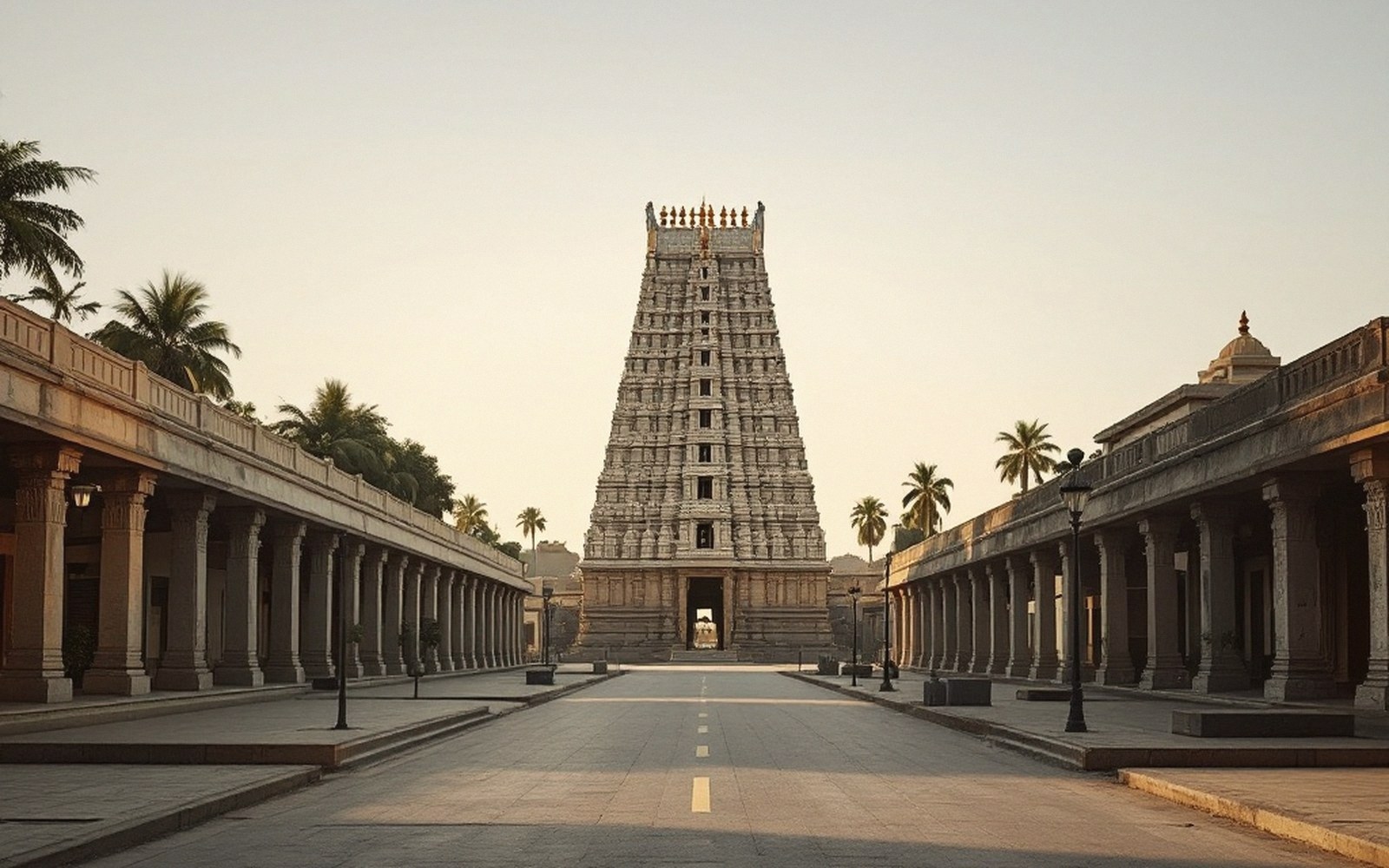
South Indian temple towns of any scale are organised around the temple on a roughly concentric plan. The mada veedhi — the car street — is the broad road that encircles the temple complex at a distance, following a rectangular or roughly rectangular path. It is on this street that the chariot moves during festival processions, travelling the full circumambulatory circuit and negotiating four corners, one at each corner of the rectangle.
The corners are the constraint. A street can be narrowed between the corners without consequence for the vehicle, but the corner itself must provide full clearance. The width of the mada veedhi in mature temple towns is therefore not uniform; historically, the critical dimension was held at the corners, and the straight sections could afford to be tighter. In towns where this logic was applied consistently from early settlement, the corners of the car street open perceptibly outward — a slight broadening that is geometric necessity, visible in the plan if not always obvious from the street level.
The relationship between chariot size and street geometry has a feedback quality. A larger chariot built for a prosperous temple in a later period required either a wider street at the corners, or a reduction in vehicle dimensions. Where the urban fabric had already consolidated, the chariot was the variable adjusted. This is partly why chariot sizes vary significantly between temples even of comparable religious importance: the vehicle was sized to the available turn, not the other way around.
Settlement follows the route
The broader implication is that the circumambulatory street shaped settlement patterns around temples that became urban centres. Commercial occupation of the mada veedhi frontage was common — the street was the most trafficked in the town and the most visible during festivals — but the setback from the building line to the street edge was governed, in practice, by the same turning geometry. Encroachment that narrowed the corner could strand the chariot. The constraint was practical and well understood; where it was respected, the town plan held its geometry over centuries.
In towns where the original street has been encroached, the consequence appears during festivals: the chariot cannot complete its circuit, or must be manhandled around corners with the kind of effort that damages both the vehicle and the road surface. The geometry written into the original plan is not recoverable once the corners are built over.
The ter is built to be disassembled and reassembled, which allows adjustment of its dimensions between uses. But the base frame — the element that sets the turning radius — is the heaviest and least variable component. The street that cannot accommodate it has lost its original function.
| No. | Item | What it is |
|---|---|---|
| 01 | ter | Tamil: the temple chariot; the vehicle used in circumambulatory festival processions |
| 02 | mada veedhi | Tamil: the car street; the broad circumambulatory road encircling a temple complex |
| 03 | Circumambulatory circuit | the full rectangular loop around the temple, negotiating four corners |
*Plumb is an independent publication about the architecture, engineering and construction of South Indian temples. It is not a travel, tourism or religious body.*