
The Count and the Claim
No hall in South India contains exactly one thousand pillars. The Airavatesvara temple at Darasuram, the great mandapas at Madurai, Vellore, Srirangam — count them and you arrive at figures like 985, or 728, or some other number that is large and precise and not one thousand. The Tamil term ayiram kaal mandapa — the thousand-pillared hall — is a category, not a measurement. A hall built to an imposing scale, dense with columns on a regular grid, earned the name regardless of the actual tally.
What the count does record is ambition about bay spacing. A pillared hall grows its column count not by enlarging the plan but by tightening the grid. Bay spacing in a granite hall is determined by the longest monolithic beam available from the local quarry; pack more columns into the same floor area and each span shortens, which means each beam can be thinner and lighter for the same load. The thousand-pillared hall is therefore partly a consequence of quarry output: shafts could be raised faster than very long lintels could be extracted, so the hall became denser rather than wider.
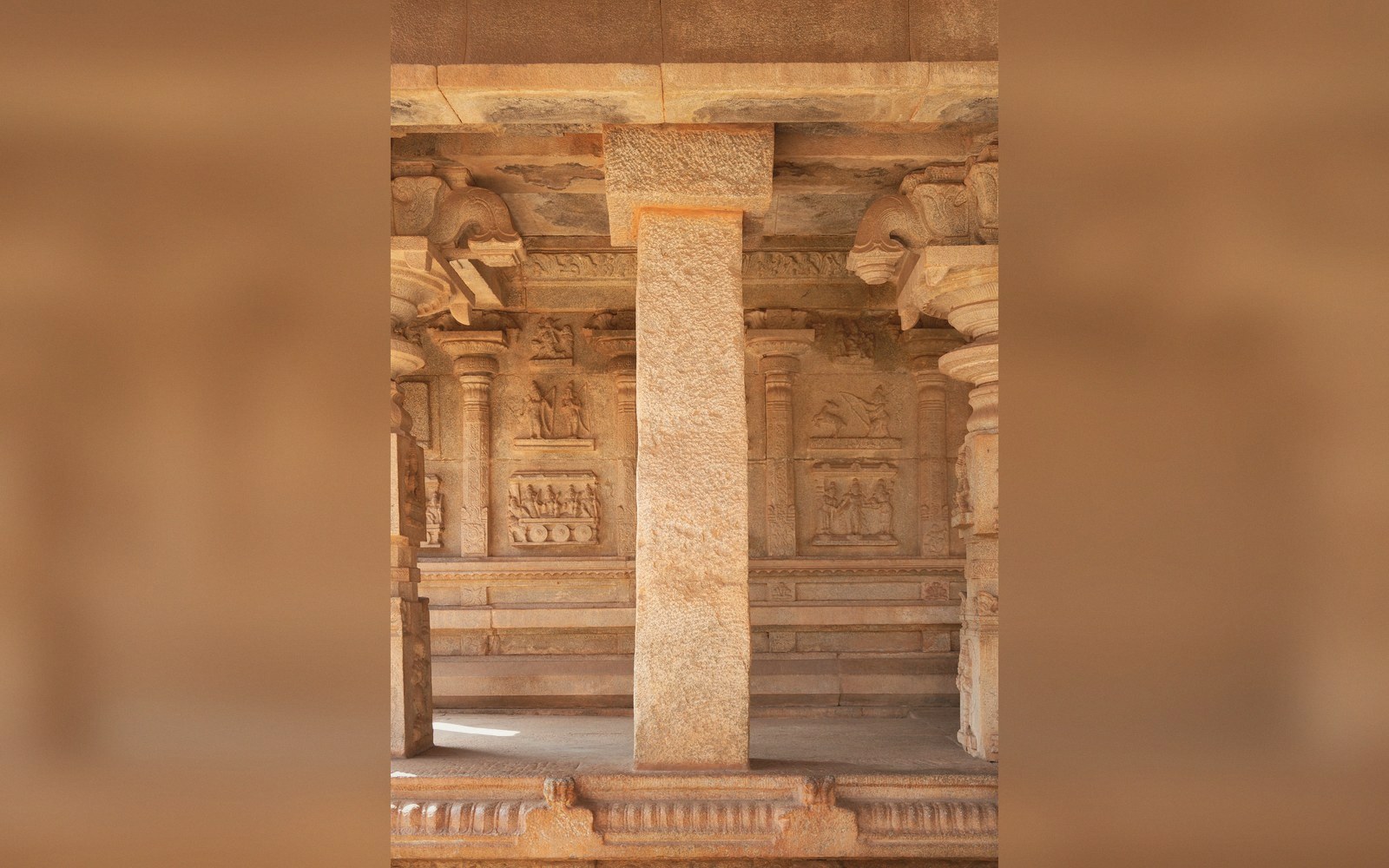
Actual column tallies in celebrated examples fall short of 1,000; the label is honorific
Photo: Hampi - Hazara Rama Temple - Mandapa - Pillar · Wikimedia Commons
The structural logic runs further than that. A monolithic shaft — one stone from base to bracket — transfers load cleanly, with no joint to open under the weight of the roof above. In a hall of this density, with columns set roughly one to two metres apart in each direction, the cumulative bearing area across the floor plan is very large relative to the load imposed. Individual columns are lightly stressed; the hall as a whole is massively redundant. One shaft can fail without the roof moving, which matters across a time horizon of several centuries and multiple seismic events.
The ornamental payoff follows directly from that redundancy. When a shaft carries little stress, its surfaces are safe to carve deeply. The compound bracket capitals — corbelled out in successive steps to reduce the beam span — are themselves load-bearing elements, but the figural carving on the shaft below them is not. The density of the hall meant that the carvers had, effectively, hundreds of lightly loaded surfaces to work. The visual richness of a large mandapa is a structural fact as much as an aesthetic one.
The claim of a thousand is a builder's shorthand for all of this: a hall large enough that no single span dominates, dense enough that individual members are lightly loaded, and old enough that the number has become a legend. The number that mattered was not one thousand. It was more than you can quickly count.
The grid of a pillared hall is set by the longest beam available, not by the plan.