The problem is not the stone
A monolithic column shaft in a South Indian pillared hall — mandapa — is not structurally complicated. It is a compression member. Granite in compression is nearly impossible to overload at these scales; the shaft does not need to be engineered so much as delivered. That delivery is what shapes every decision about where mandapas get built and how large their columns grow.
The shafts are cut from outcrops of granitic gneiss, the same rock that forms the low, rounded hills scattered across Tamil Nadu. The quarrymen read the natural jointing to find a block that will yield a clean rectangular section without internal fractures. A line of wedge holes is cut along the grain, wooden or iron wedges driven and — where wood is used — wetted so the expansion of the fibre finishes the split. What comes off the hill is rough-hewn to approximate final dimensions at the quarry face, because every unnecessary kilogram is weight that must be dragged cross-country.
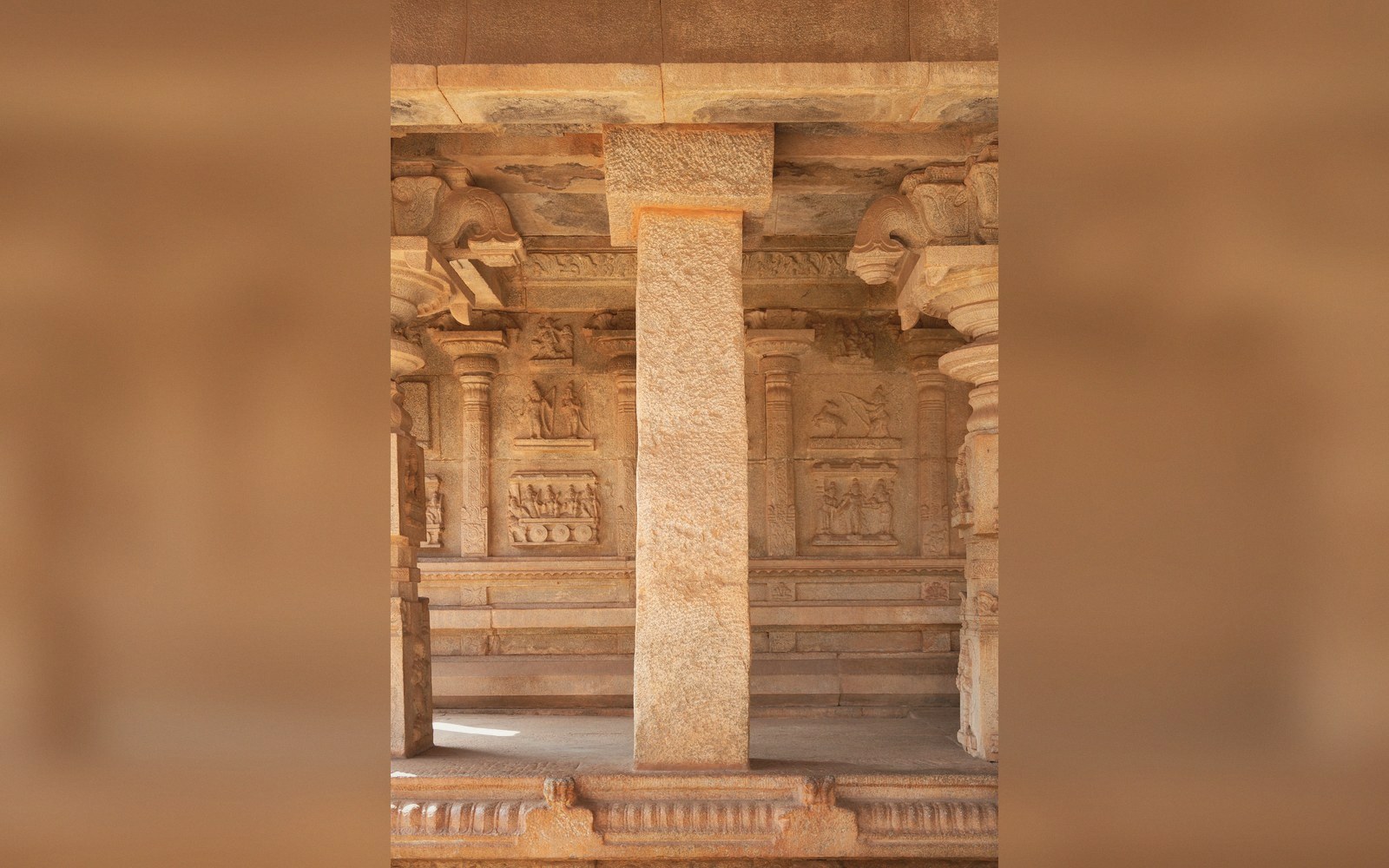
Estimated weight of a 4-metre dressed granite shaft: 6–8 tonnes depending on section
Photo: Hampi - Hazara Rama Temple - Mandapa - Pillar · Wikimedia Commons
The transport problem has three parts: getting the shaft down off the outcrop, moving it across flat ground to the site, and standing it upright once it arrives. The first and third are handled by gravity and its controlled reversal — earth ramps, levers and the controlled release of supporting material. The middle leg, overland haulage, is the binding constraint. A shaft four metres tall in dressed granite can weigh six to eight tonnes. There were no wheeled vehicles capable of carrying that load on unpaved ground, so the shaft goes on wooden sledges, pulled by teams whose size is set by the coefficient of friction between wood and packed earth, and by the capacity of the rope. River transport was used where the geography allowed; the proximity of many major temple complexes to navigable water is not coincidental.
Once on site, the shaft is walked upright from horizontal using a gin-pole arrangement and incremental packing — earth or stone wedged under the rising end until the centre of gravity crosses the base. A shallow socket cut into the plinth stone receives the foot; no fixing compound, no dowel. The weight of the shaft itself — and everything stacked on it — holds it in place. Lateral stability comes from the grid of the hall as a whole: bay spacing locks each shaft against its neighbours through the beams and slabs above.
The finished surface is dressed on the visible faces only, the ornamental profiles cut after the shaft is standing. Below the floor line, where the foot sits in its socket, the stone is left rough.
The grid of a pillared hall is set by the longest beam available, not by the plan.