What the Tank Is Actually Doing
The standard description of a temple tank treats it as a container — something that holds water the way a pot holds water. That is wrong in the important sense. A tank cut into granitic or laterite terrain is a calibrated excavation: it goes down until it intersects the local water table, and it stays full because groundwater seeps in through the floor and walls. No pipe, no channel, no lifting mechanism is strictly necessary. The geometry does the work.
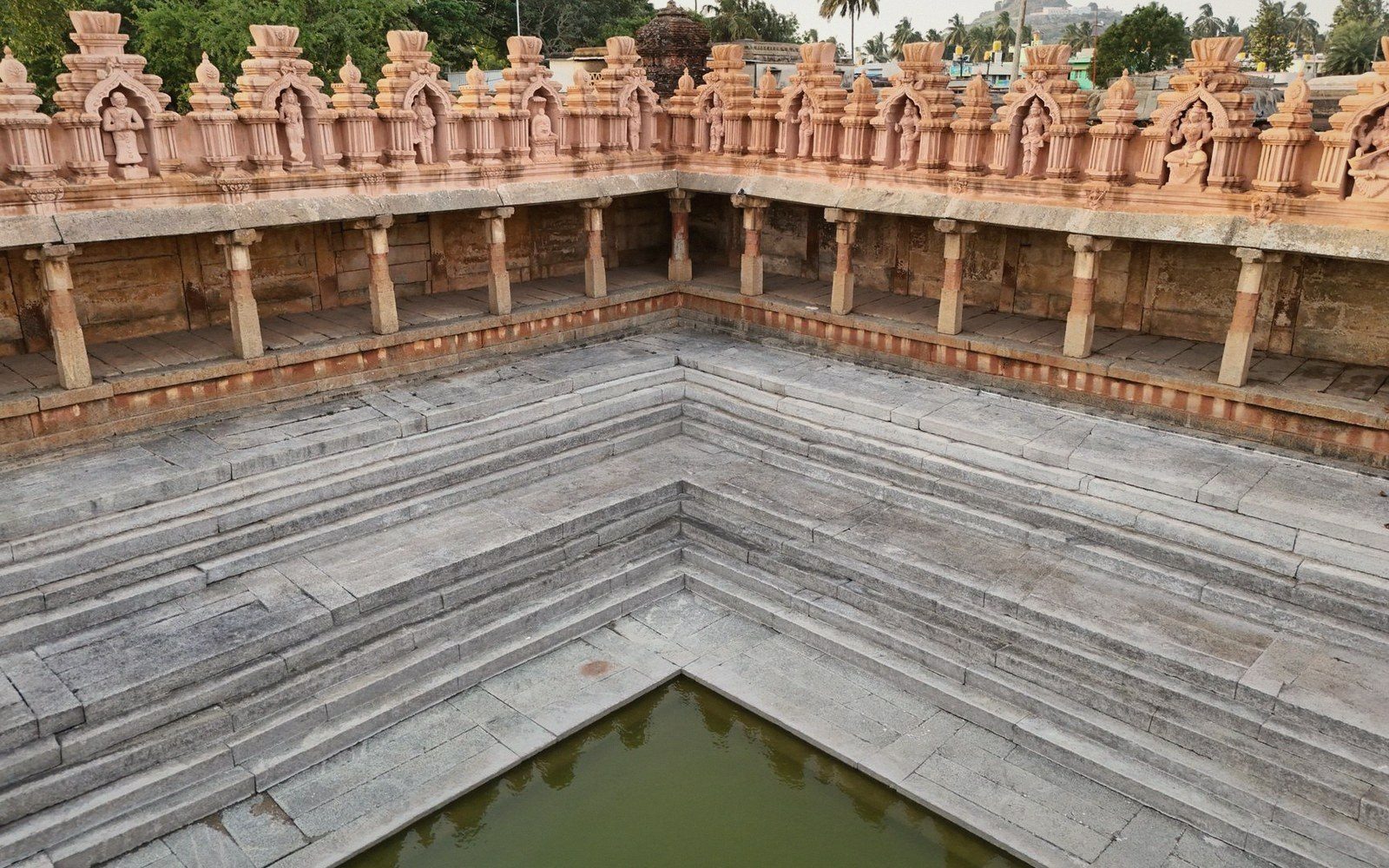
This means the water level inside the tank is not set by whoever built it. It is set by the aquifer. In a good monsoon the water table rises and the tank fills higher; in a drought year it drops. The structure built around this fact is the stepped descent — a series of terraced landings, typically in stone, that ring all four sides from the top of the tank down to its floor. Those steps are not ceremonial furniture added after the hydraulics were sorted out. They are the reading instrument. At any moment, the water surface sits against a particular step, and anyone who knows the normal range can see at a glance whether the aquifer is up or down.
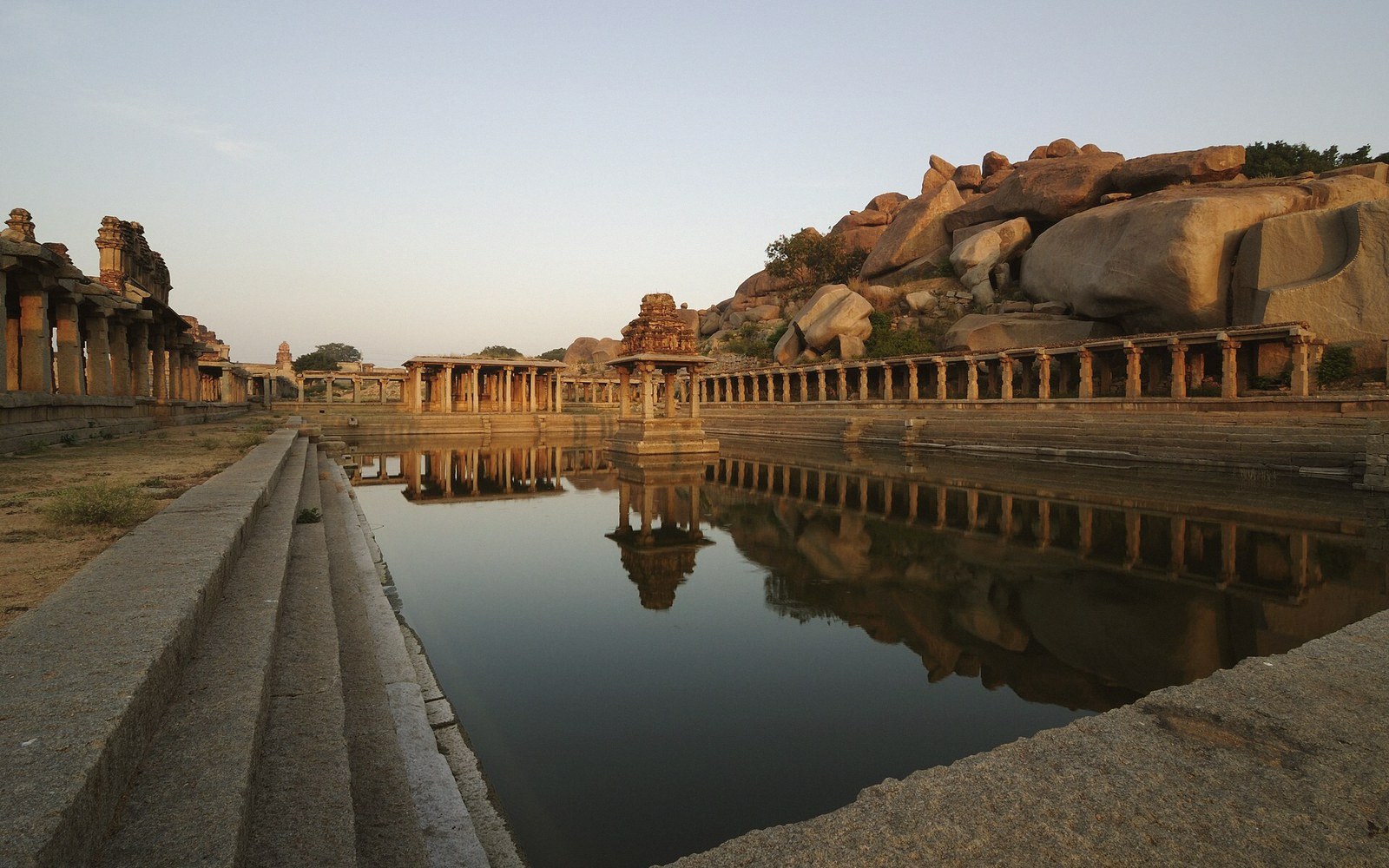
Level indicator — water surface reads against a named step; visible from the tank edge
Photo: Krishna Pushkarani - Hampi Ruins · Wikimedia Commons
How the Steps Work as Structure
The stepped profile solves several problems at once. A vertical masonry wall against a waterlogged soil is under continuous lateral pressure — water-saturated ground pushes hard, and the force is not uniform with depth, it increases. Terracing the sides into broad, heavy steps distributes that pressure differently: each step is a wide footing, and the mass of stone in the treads and risers resists the inward push through dead weight and friction rather than through bending strength. The same logic governs a rubble retaining wall on a slope, except that the tank builder is working in three dimensions, and the geometry must be right on all four sides simultaneously.
The tread width matters as much as the riser height. A narrow tread concentrates load at the edge; a wide tread spreads it and provides a stable platform that resists overturning. The dressed granite used in the better Chola- and Vijayanagara-era tanks was laid dry or with minimal lime mortar, relying on close bed-dressing and weight — the same principle that governs dry-laid surface joints elsewhere in the temple complex. Waterlogged stone still behaves as stone: the geometry of bearing surfaces does not change when the joint is wet.
| No. | Item | What it is |
|---|---|---|
| 01 | Structural logic of terracing | mass and friction resist lateral soil pressure; wide treads distribute load |
| 02 | Silt maintenance | stepped profile allows access to floor as water drops; steps act as scaffold |
The Descent as Data
Because the water level is free to sit anywhere on the stepped face, the steps encode a useful record. Tank builders working from experience knew roughly where the water table stood and how much it moved seasonally. They cut the depth of the tank — and therefore the number of steps — to cover that range and leave margin. A tank with more steps than the normal seasonal swing typically represents either a conservative estimate of the drought minimum or a site where the aquifer varies unpredictably. A tank cut too shallow would be dry half the year; too deep, and the lowest steps never emerge and the floor silts without being reached for cleaning.
Silt is the persistent maintenance problem. Fine particles settle to the floor during high-water periods and compact. A tank whose steps are accessible at low water can be entered, the silt scooped, and the floor inspected. The stepped geometry makes periodic de-silting physically possible in a way that a smooth-walled pit would not. The steps double as a working scaffold descending into the basin as the water drops.
| No. | Item | What it is |
|---|---|---|
| 01 | Chola and Vijayanagara eras | periods producing the best-documented stone-dressed tank construction |
| 02 | Tamil Nadu, Karnataka, Andhra Pradesh | regions with surviving, functioning examples |
| 03 | Continuous maintenance for several centuries | the tanks that survive are those that kept being de-silted |
What the Level Tells You Now
Where old tanks survive and still hold water — there are many across Tamil Nadu, Karnataka and Andhra Pradesh, some continuously maintained for several centuries — the step at which the water currently rests carries real information about the regional water table. That information is legible without instruments. It is legible to anyone who can count steps and remembers where the water stood last year. The builders embedded a groundwater gauge into the structure and gave it a surface-area large enough to read from across the courtyard. That is engineering doing several jobs with one set of stones.
*Plumb is an independent publication about South Indian temple architecture and engineering. It is not a travel guide, tour operator, religious authority or heritage body.*
Access at every level, and a structure that does not fail as the level drops.