
What the steps are actually doing
A temple tank — pushkarini or teppakulam depending on region — is not a container filled from above. It is a pit excavated to the water table, and its water level moves with the aquifer through the year. In the dry months before the monsoon, the surface may drop several feet. In the weeks after it, it rises again. The steps track that movement.
Each tread gives a landing point at a different elevation. At any water level, a course of steps sits just above the surface and another just below — the user can reach water without standing at the edge of a vertical drop into an uncertain depth. That is the practical function: continuous access across a range, not a fixed staircase to a fixed level.
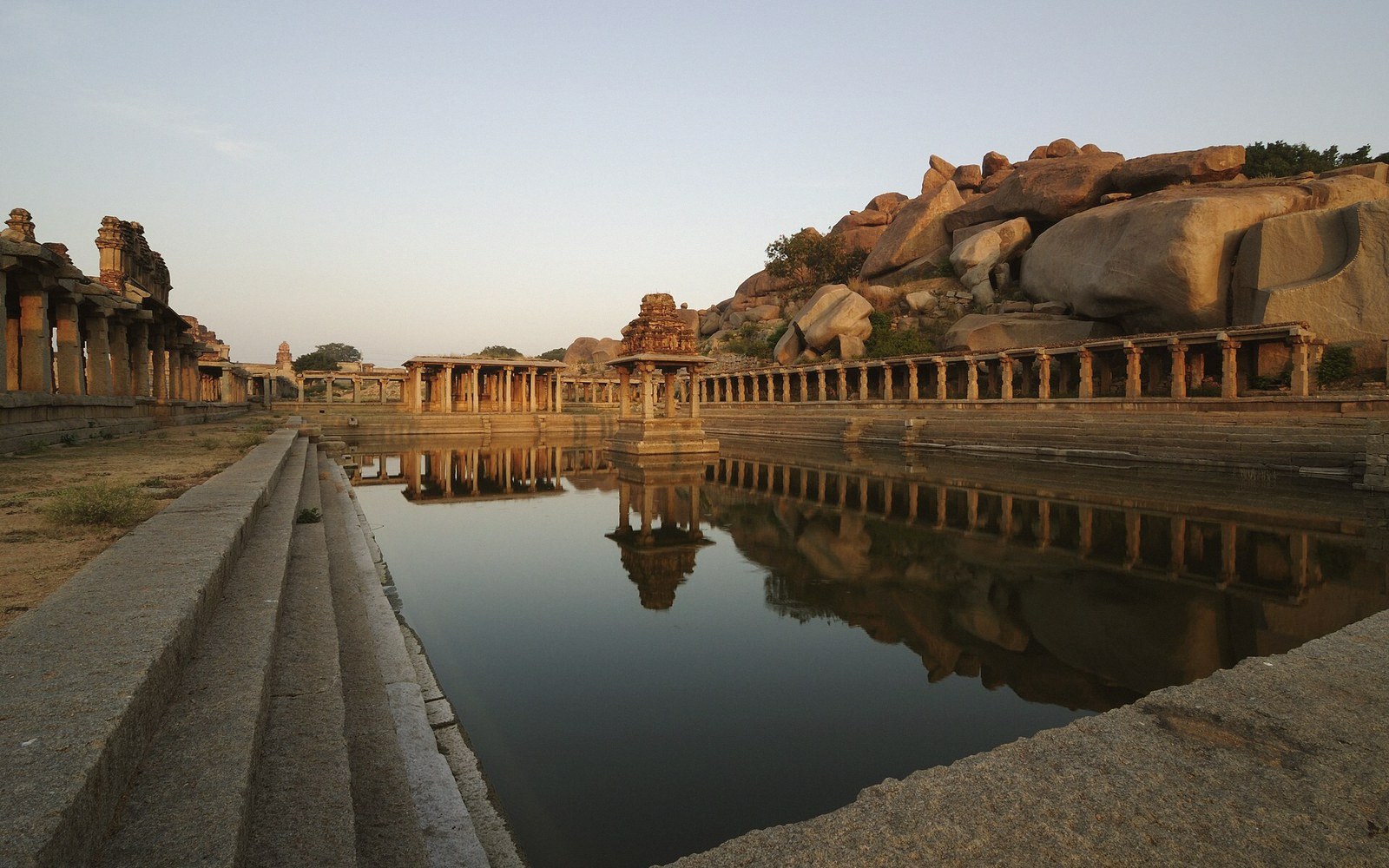
Lateral hydrostatic pressure — outward force exerted by stored water on a retaining wall
Photo: Krishna Pushkarani - Hampi Ruins · Wikimedia Commons
The structural logic is equally straightforward. A sheer vertical wall retaining a large body of water resists lateral hydrostatic pressure by bending, which demands either mass or reinforcement. A stepped profile solves the same problem differently. Each receding course is narrower and lighter than the one below it, so the geometry converts what would be a tall retaining wall into a series of shorter, gravity-stabilised steps, each bearing down on the one beneath. The load path goes into compression through the masonry, not into bending.
Granite is the common material — dressed blocks laid in level courses, often without mortar on the bed joints, relying on accurate dressing and the weight of the stone above to hold position. Dry-laid beds work here for the same reason they work elsewhere in South Indian masonry: full contact across a flat surface distributes load evenly. Where the dressing is good and the courses are deep, the wall does not need a continuous bond to stay stable. Joints that hold without mortar is the same principle operating vertically rather than horizontally.
| No. | Item | What it is |
|---|---|---|
| 01 | Stepped profile vs. sheer wall | steps convert bending load into gravity-compressive load through shorter, stacked courses |
| 02 | Dry-laid granite beds | flat dressing and stone weight do the work that mortar would otherwise do |
| 03 | Tread width | wider treads resist uplift from saturated ground; shallow angle approaches a revetment |
The tread-to-riser ratio in surviving tanks varies, but a wide, shallow tread is structurally preferable. It increases the plan area of each step, improving its resistance to sliding under uplift pressure from saturated ground, and it gives the whole assembly a lower effective angle — closer to a revetment than a wall.
What results is a structure that reads its own water level continuously. When the tank is full, the upper steps are submerged and the lower ones hidden. As the level drops, steps emerge. The steps are the gauge.
A temple tank is cut to the water table, not filled from above. The stepped sides are the gauge: