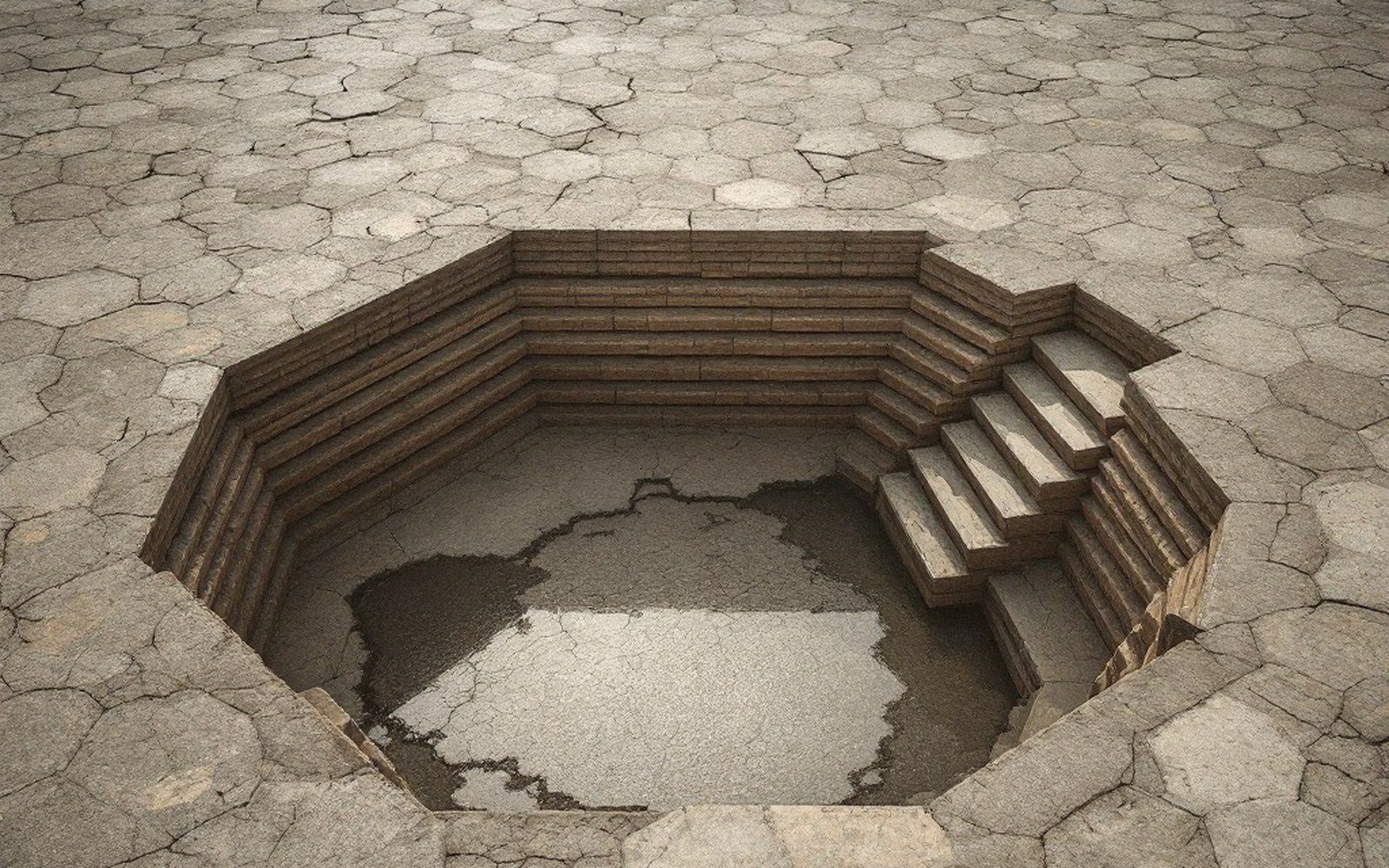
A temple tank is cut to read the water table. Over decades, the same water that fills it carries suspended clay and fine sand, and that material settles. Without removal, a tank that once held four metres of water holds two, then one, then becomes a reed bed that dries out in summer and floods in monsoon. The engineering of the original cut is undone not by structural failure but by accumulation.
The rate is not dramatic. In a catchment of modest size, silt deposition measured in functioning tanks runs to a few centimetres per year — imperceptible season to season, decisive over a generation. The stepped ghats, the dressed stone risers that give access at every level, become progressively buried from the bottom upward. When the lowest courses disappear, the tank has lost not only depth but its built-in gauge: the relationship between water level and step that tells anyone standing at the edge how full the system is.
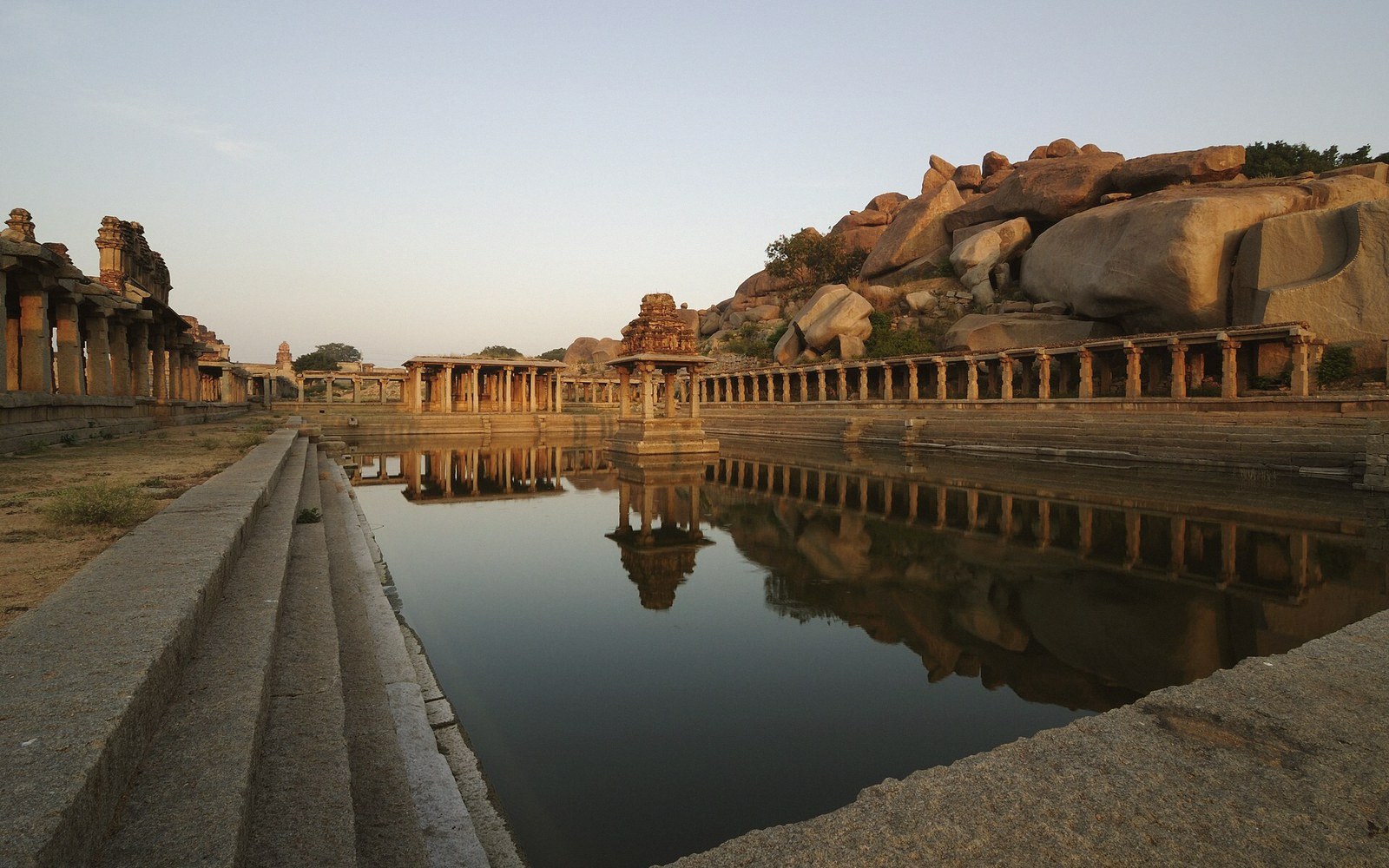
Ghat burial — lowest stone risers disappear first as silt accumulates, destroying the tank's depth gauge
Photo: Krishna Pushkarani - Hampi Ruins · Wikimedia Commons
Removal was periodic, institutional work. Dry-season desilting parties — organised through temple administration or by the communities the tank served — would enter the exposed bed, loosen the accumulated layer and carry it to the bund margins or to adjacent fields, where it was genuinely valued as fertiliser. This was not incidental: the nutrient load in tank silt is high, and the agricultural return gave the labour an economic logic outside of piety or obligation. When that economic relationship broke down — when landholdings fragmented, when the communities who farmed the tank's catchment dispersed — desilting stopped. The tank silted. The sequence is consistent across the Tamil plains and has been documented repeatedly in surveys of tank irrigation systems.
Original engineering (the cut, the dressed ghats, the dry-set stone) can outlast the maintenance cycle by centuries — the stone does not fail; the organisation does
The structural stone is almost never the problem. Dressed granite set without mortar does not rot, and the joints that have held for centuries will hold for more. What fails is the maintenance cycle, and the maintenance cycle fails when the institution that organised it loses its mandate or its people. Silt is slow, and slowness is precisely what makes it fatal: there is no single event to respond to, only a condition that worsens until reversal becomes excavation.
A temple tank is cut to the water table, not filled from it. The stepped sides are the gauge,