
Getting water to the tank
A temple tank sits at a fixed level, cut into the ground until the masons reached the water table. That gives it a floor and a permanent minimum, but it does not fill the tank. Rain falling directly onto the tank surface contributes almost nothing — the tank's plan area is small relative to any useful catchment. The water arrives by channel from higher ground: from a river, from a larger irrigation tank upstream, or from the runoff collected across a wide catchment bund.
The channel that carries it is cut at a slight continuous gradient — enough to keep the water moving without scouring the bed. Too little fall and the channel silts faster than it can serve. Too much and the bed erodes, undercutting the banks and eventually collapsing the line. In practice, channel engineers working in granite-heavy terrain had a simpler constraint: where the rock outcrops, the channel is cut directly into it, and the gradient is partly given by the topography rather than chosen freely.
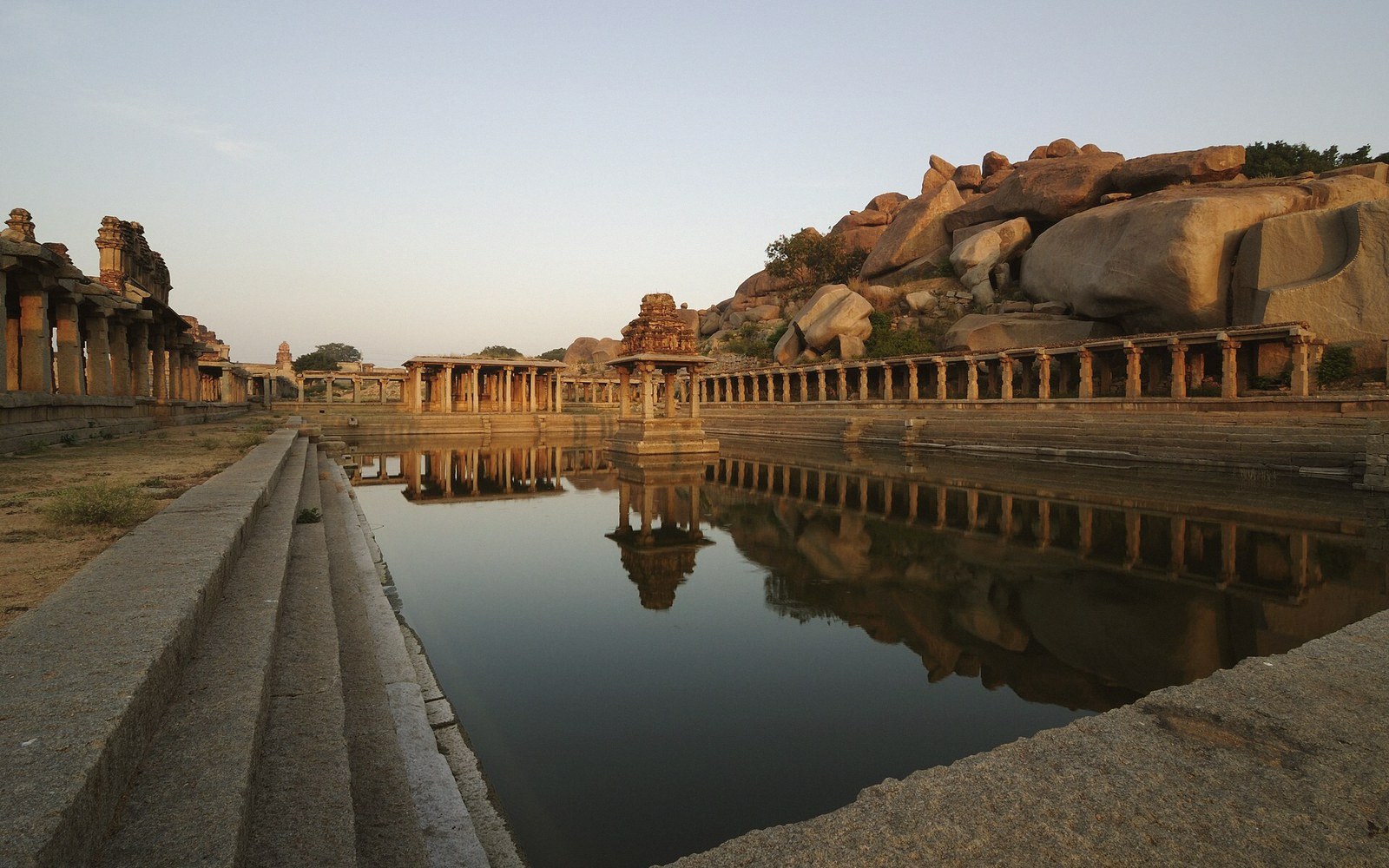
Channel gradient must be continuous and slight: enough to prevent silting, not so steep it scours
Photo: Krishna Pushkarani - Hampi Ruins · Wikimedia Commons
Stone-lined channels survive in better condition than earthen ones, but even a stone-lined channel requires a consistent cross-section. The bed and walls are dressed flat enough to prevent differential scour — not fine work, but level work. A change in cross-section area means a change in flow velocity, and an abrupt narrowing deposits sediment immediately upstream. Silting at the inlet is the failure mode that destroys the usefulness of the channel long before the tank itself is compromised.
Where the feeder enters the tank, it typically passes through a sluice: a vertical slot cut into the inlet wall, fitted with a removable stone or timber gate. The sluice does two things. It lets the inlet be closed when the channel carries heavy sediment load after a sudden rain — that first flush is muddier than useful. And it allows the flow to be stopped entirely when the tank needs maintenance. The gate fits into a dressed groove; the weight of water presses the gate into its groove and would force the opening wider if the fit were loose, so the groove is cut tight and the stone sits true.
The fall required is not large. A channel running several kilometres may lose only a metre or two in elevation over its full length. What matters is that the fall is unbroken — no flat sections where the water stalls and drops its load — and that the inlet sits higher than the maximum water level the tank can hold. If the channel invert falls below the tank's full-supply level, the tank runs backward through its own feeder the moment the upstream source drops.
A temple tank is cut to the water table, not filled from it. The stepped sides are the gauge.