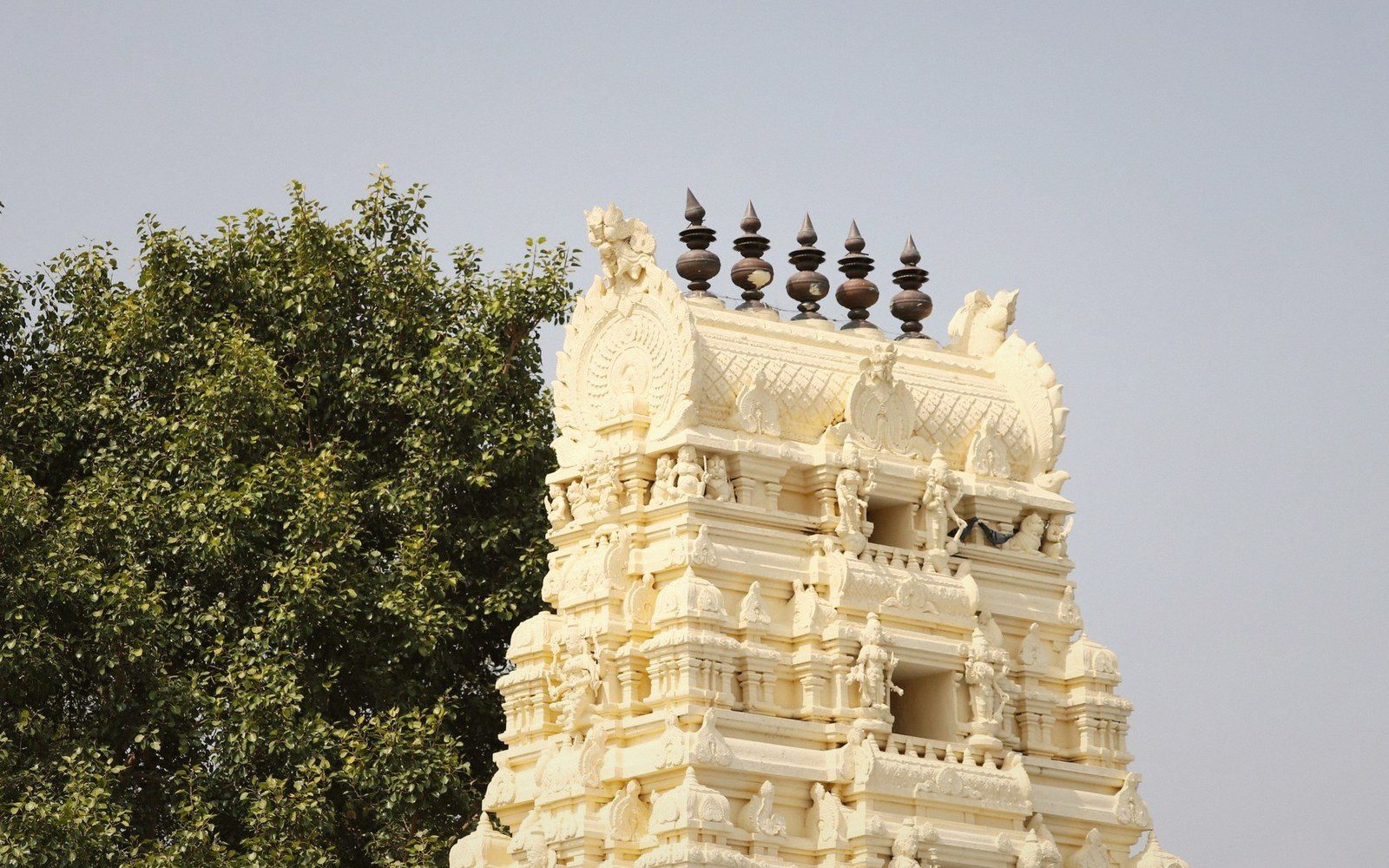
The only free element
A gopuram — the towered gateway of a Dravidian temple — is a compressive structure from foundation to finial. Every element below the crowning tier carries the weight of something above it. The kalasha (pot-shaped finial) does not. It sits on the ridge of the uppermost barrel vault, held by a short stem, and the only load it transmits is its own modest mass directly downward through that stem. Nothing spans between kalashas; nothing rests on them. They are structurally inert.
That makes them unusual in this tradition. The granite plinth carries the superstructure. The pilasters on each tier are bonded into the brick-and-stucco shell and help distribute lateral pressure. Even the decorative pilasters — which carry no discrete beam — are part of a continuous skin that stiffens the wall. The kalasha alone is genuinely ornamental in the engineering sense: remove it and the building does not change state. It does not become unstable; nothing above it needs supporting because there is nothing above it.
stem — short iron or copper pin set into the masonry ridge on which the kalasha sits
Photo: Jorge Urosa / Pexels
The consequence of being load-free is that the kalasha can be — and usually is — made in copper or gilded copper alloy rather than stone, cast or raised by hand, mounted on an iron or copper stem set into the masonry. It can be replaced without scaffolding reaching below the final tier. It can be removed for refurbishment and returned. Several temples record periodic replacement of kalashas after storm damage; the repair work is confined entirely to the finials, which says something about both their vulnerability and their independence from the rest of the structure.
The irony of the kalasha's position is architectural. It is the most visible element on the skyline, the element that reads as the peak and completion of the whole composition, the part that catches the light at the rim of the barrel vault — and it is the one part of the elevation that the structure below it could entirely ignore.
A gopuram is a stack of named parts. Read them in order and the taper explains itself: the section carrying the most is at the bottom, and every tier above sheds weight.