
The record in the stone
Granite does not weather fast. The feldspars in a coarse Deccan granite take centuries to hydrolyse noticeably, and the quartz barely responds to rainwater at all. What eight hundred years of monsoon does to a dry-laid granite temple is less than most visitors assume, and the damage it does is instructive about where the system is weak.
The bed joints — the horizontal surfaces that carry load — are largely self-protecting. A well-dressed bed sits tight across its full bearing area, and surface water that reaches the joint has almost nowhere to pool. Capillary draw is minimal between two faces in near-full contact. The stones themselves are thick enough that the thermal mass stays cool relative to the air above, limiting the freeze-thaw cycling that breaks stone in other climates. Tamil Nadu does not freeze. What it has is heat, humidity and approximately three months of serious rainfall each year.
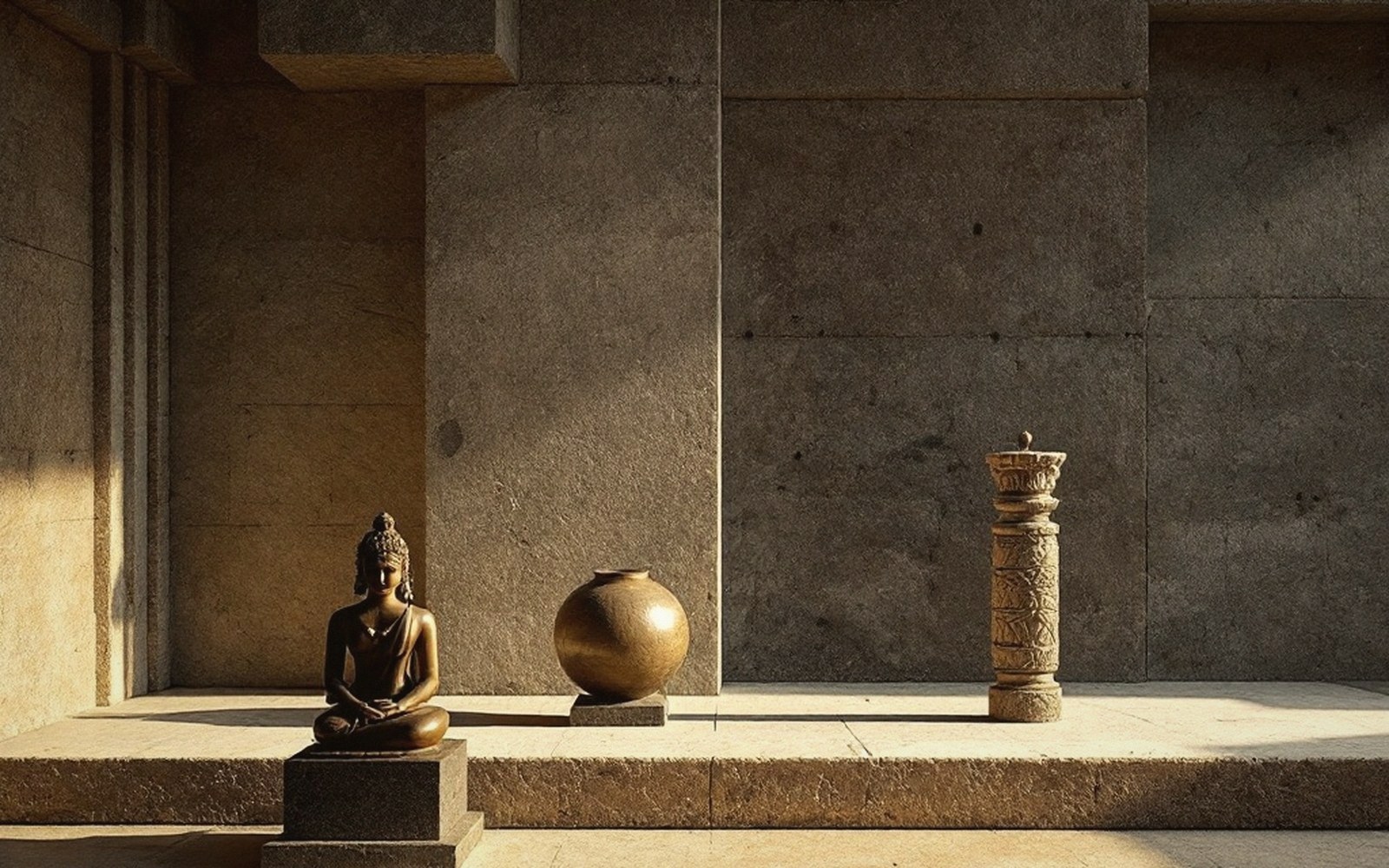
Perpend joints (vertical) open to sky — the weak points
The vulnerabilities are specific. Vertical joints — the perpends between adjacent blocks — are open to the sky at the top of any horizontal run, and water sits there longer. If the stone carries a concave carved profile immediately above a joint, water lodges in the hollow and works on the boundary between two adjacent blocks. Dissolved iron from the stone stains the face orange-brown; this is surface chemistry, not structural loss. More consequential is any joint where one face is slightly higher than the other, creating a check that traps silt. Silt holds moisture against the stone face long after rain stops. Over decades, that sustained dampness does what brief flooding does not: it gives biological colonisers — algae, then lichen, eventually moss rooted into micro-cracks — a foothold. The mechanical wedging of moss rhizomes in an already-open joint is a slow but real force.
The most consistent weathering damage in surveyed Chola- and Vijayanagara-period structures appears not at the base, where the plinth sits above finished ground, nor at mid-height where courses are protected by their own overhangs, but at the transition zones: where a granite plinth hands off to brick-and-mortar superstructure, and where drainage from an upper platform discharges onto a lower stone surface. Those are points of concentrated water flow, differential thermal movement and different material response. The granite endures; the joints at material boundaries do not.
The open joint, then, is not an oversight corrected by later masons. It is a system that works within a climate that rarely freezes and on a stone that responds slowly — until it meets accumulated silt, standing water, or another material.
Dry-laid granite relies on bed area, dressing and weight. Where that works and where it needs help.