
The work goes down, not out
A granite block has six faces. Two of them — top and bottom — determine how the building stands. The other four are what a visitor sees. In South Indian temple construction, the mason's attention goes to the beds first, and the visible faces last.
The bed joint is the bearing surface: the plane across which load transfers from one course to the next. If that surface is uneven, contact becomes partial. Two blocks in full contact share the load across the whole area; the same two blocks resting on a ridge of high stone meet at a line, or a point, and the stress concentrates there. Granite is hard, but it will crack under point load, and a crack that begins at a bed joint propagates under every course above it. The arithmetic of bedding and bearing is simple: more contact, lower stress.
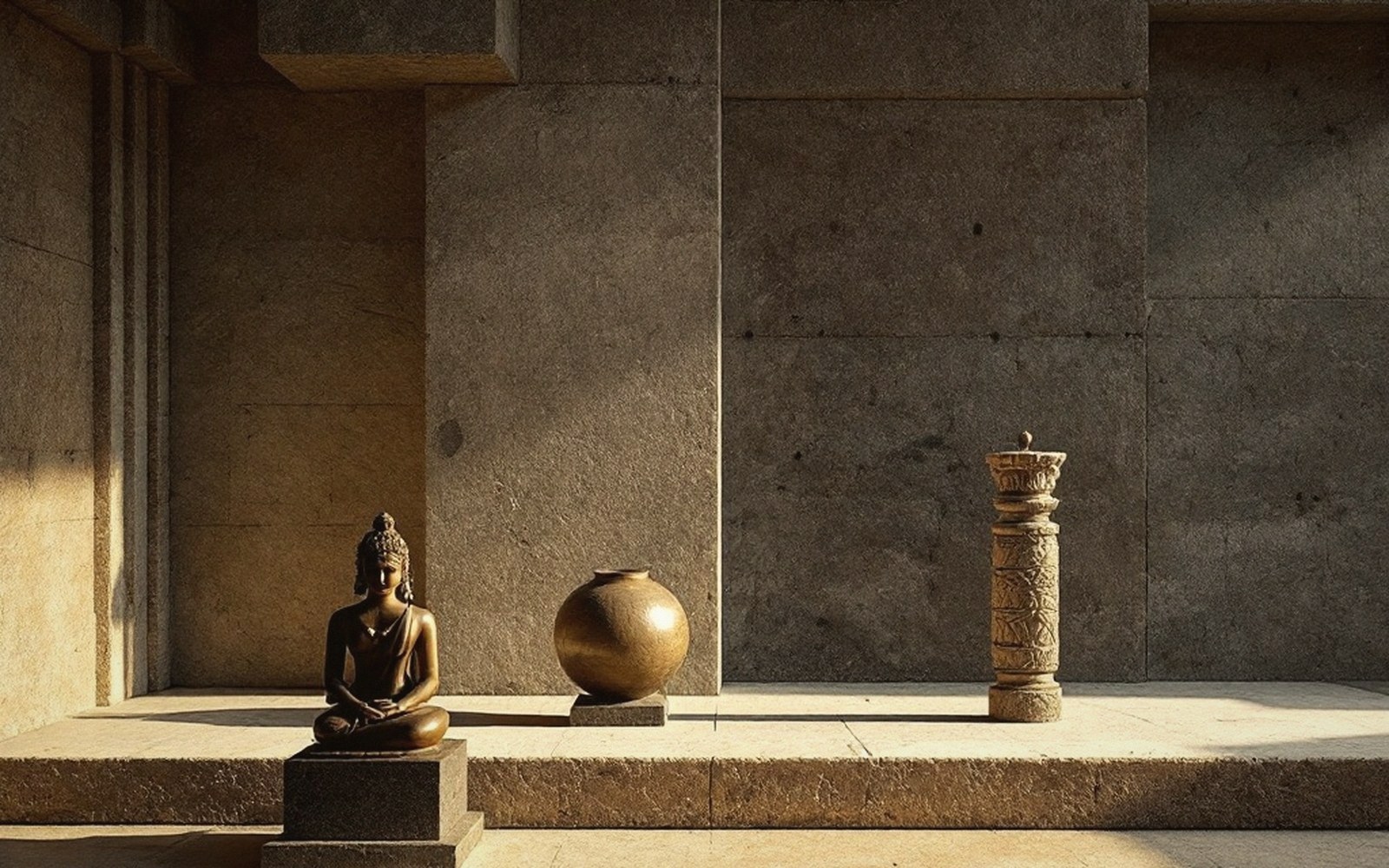
Exposed face — carved with mouldings and registers after the block is laid
So the bed is dressed flat — worked with a punch chisel across the whole surface until it sits without rocking. The test is contact, not appearance. A straightedge reveals a high spot; the mason removes it; the block is offered up again. Nothing is mortared. The joint holds by weight and by the friction of stone on stone, and neither works if the surfaces do not meet.
The face tells a different story. In the lower courses of a gopuram or the plinth of a mandapa (pillared hall), the exposed surface carries carved mouldings — cyma profiles, lotus bands, the repetitive horizontal registers that make up the adhishtana (base podium). These are cut after the block is laid, sometimes while the course above is already seated. The carving is cosmetic in the structural sense: it removes stone only from the face, not from the loaded cross-section behind it. The wall behind the ornament is full-depth granite doing its job undisturbed.
This priority is visible wherever a course has been robbed or shifted: the beds, when exposed, are smooth and true; the back faces, never meant to be seen, are left rough from quarrying. The investment in labour follows the investment in load. Surfaces that carry get dressed. Surfaces that are merely looked at get carved.
Dry-laid granite relies on bed area, dressing and weight. Where that works and where it needs help.